
The transformation of academic assessment models within the United States higher education system over the past decade has cemented remote proctoring frameworks as standard operating procedure. From large state institutions like Arizona State University and the University of Central Florida to elite private universities, the reliance on digital oversight mechanisms remains absolute. However, as institutions deploy highly complex, artificial intelligence-driven identity verification, biometric analysis, and environmental scanning software, an implicit technical problem has surfaced. Students are no longer evaluated solely on their mastery of academic concepts; they are concurrently restricted by the performance thresholds of their consumer hardware. When high-stakes midterms or finals are arbitrated by automated proctoring suites, a minor software conflict or kernel-level memory leak can manifest as a catastrophic system failure, terminating an exam session prematurely and inducing severe psychological and administrative strain.
This technical disconnect becomes obvious when examining the operational footprint of remote monitoring utilities. Software applications such as Respondus LockDown Browser, Honorlock, Proctorio, and Examity are not passive web applications; they act as comprehensive, intrusive operating system overlays. Upon execution, these programs initiate kernel-level alterations, seize control of system drivers, terminate background tasks, and establish persistent, multi-channel media pipelines capturing high-definition video, multi-source audio, and real-time desktop rendering. For a standard student laptop running consumer-grade hardware configurations, this multi-layered processing load introduces substantial performance bottlenecks. In the current academic climate, the pressure to secure high GPAs leaves no margin for computing vulnerabilities. When specialized computing projects or complex source codes overlap with these stressful periods, students often require external academic support. Utilizing professional pay someone to write my assignment can help manage intense coursework without overloading physical workstations.
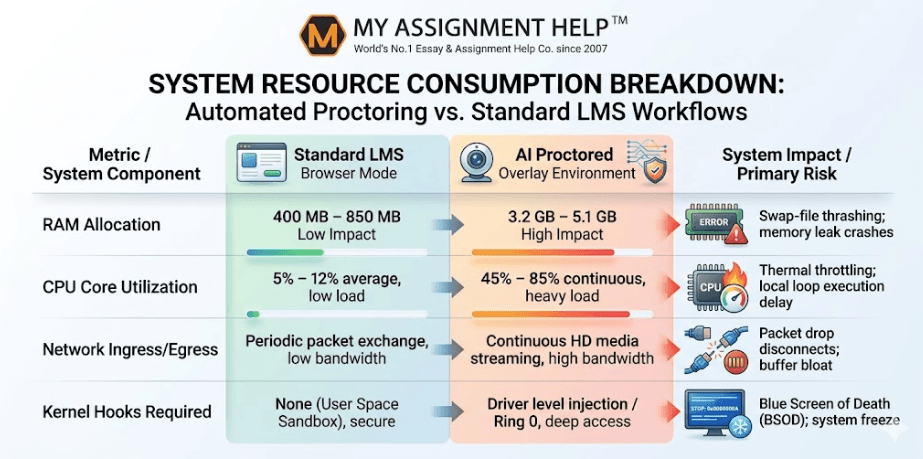
To quantify the true impact of remote exam infrastructure on student machines, one must analyze the physical resource draw of these applications. Standard web browsers operating cloud-based testing suites like Canvas or Blackboard typically demand between 400 MB and 850 MB of Random Access Memory (RAM). Conversely, when an automated tracking utility injects its background verification threads, secondary security modules, and continuous web-camera encodings, the system memory overhead increases exponentially. For instance, runtime logs demonstrate that an active tracking session can easily swallow upwards of 3.8 GB of physical RAM, pushing entry-level laptops with standard 8 GB capacities into heavy swap-file utilization. When an operating system is forced to swap memory blocks onto a physical solid-state drive or hard disk to compensate for RAM starvation, system responsiveness falls off a cliff. If a technical freeze occurs mid-test, the consequences are immediate: the automated algorithm flags the user for anomalous inactivity, the connection to the university database severs, and the student is locked out. Recognizing this technical vulnerability, an increasing volume of modern scholars seek optimized testing setups or turn to trusted online exam help to safely navigate these system requirements and ensure their evaluations are processed on high-throughput, stable configurations.
The Anatomy of Proctored Software Overloads
Understanding why consumer laptops falter during high-stakes evaluations requires a deep-dive analysis of the system-level behavior of modern proctoring tools. Unlike standard commercial applications that operate within the sandboxed limits of a user-space environment, remote monitoring software requires deep integration with the core operating system layer. Upon authorization, the program establishes hooks into the graphics card driver, the audio stack, and the network transport layer. It continuously captures an array of external data points: a real-time face-tracking video stream, an ambient noise audio stream, an active monitoring pipeline tracking cursor coordinates, and background processes parsing peripheral ports for unauthorized storage drives.
This extensive operational portfolio generates a massive data-processing requirement that must be executed locally on the client machine before being compressed, encrypted, and uploaded to remote cloud servers. The primary point of failure is often located within the system’s central processing unit (CPU). Real-time computer vision models operating locally on the student machine—used to track eye movements, head orientation, and facial geometry—rely heavily on floating-point arithmetic. If a machine lacks an integrated neural processing unit or a dedicated graphics card, these calculations fall squarely upon the primary CPU cores. If the processor encounters a temporary thermal throttling state due to prolonged utilization, the frame rendering rate drops below the minimum threshold required by the proctoring software’s security policy. The application frequently interprets this internal frame-rate drop as a deliberate attempt to manipulate the video stream, resulting in automated flags or instant session termination.
Quantifying the Mathematical Overhead of Live Monitoring
To mathematically model the volatile memory parameters governing a proctored examination environment, content strategists and system architects utilize basic memory headroom equations. The baseline total operational memory exhaustion (M_{total}) of a target laptop can be formulated as follows:
\text{Equation 1: } M_{total} = M_{os} + M_{lms} + M_{proc}(v_{fps}, a_{kbps}) + \sum_{i=1}^{n} B_i
Where:
- M_{os} represents the irreducible memory footprint required by the underlying operating system (Windows 11 or macOS Sequoia).
- M_{lms} represents the memory consumption of the base Learning Management System (e.g., Canvas, Blackboard Ultra, Brightspace).
- M_{proc} represents the dynamic function of the proctoring overlay relative to video frame rates (v_{fps}) and audio encoding bitrates (a_{kbps}).
- B_i represents the memory pull of un-terminated background daemons, localized security suites, or cloud synchronization tools.
If the user’s available physical hardware memory capacity (M_{available}) satisfies the following critical constraint inequality:
\text{Inequality 1: } M_{available} – M_{total} < 512 \text{ MB}
The client system shifts instantly into a critical page-allocation failure loop, directly triggering localized browser freezing, frame drops, and communication drops with the host portal. This mathematical reality emphasizes the delicate technical rope US college students must walk during major assessments.
Step-by-Step Hardware Preparation and Mitigation Framework
To safeguard your system against unexpected hardware errors during a mid-term or final exam, you should implement a series of optimization protocols before launching your testing platform. These procedures are designed to maximize available system memory, reduce thermal buildup, and stabilize network routing paths.
1. Execution of a Cold System Purge
A standard warm reboot of a modern operating system frequently fails to clear cached memory structures, persistent background service modules, or deferred update sequences. To prepare your system for an exam, you should execute a hard cold shutdown. Power down the machine completely, sever all power connections for approximately sixty seconds to clear volatile memory registers, and boot the system clean. This step ensures that system memory starts at its lowest possible baseline configuration before launching heavy exam applications.
2. Disabling Content Synchronization and Background Overlays
Cloud synchronization engines, such as Microsoft OneDrive, Google Drive Desktop, and Apple iCloud Drive, operate with aggressive, non-deterministic system synchronization policies. If these platforms initiate a heavy file upload sequence while you are taking an exam, they can saturate local storage disk write speeds and network upload bandwidth simultaneously. Furthermore, gaming overlays like the Discord Overlay, Xbox Game Bar, or NVIDIA GeForce Experience utilize high-priority hardware hooks that directly conflict with the security scripts embedded within secure testing browsers. You should use your operating system’s Task Manager or Activity Monitor to manually terminate these background processes before beginning an assessment.
3. Optimization of Local Thermal Dynamics
As detailed in the resource consumption matrix, remote testing platforms subject the primary processor to continuous, high-intensity calculation cycles. If a laptop is placed on a soft surface—such as a bed, carpet, or blanket—its lower ventilation ports are blocked, causing rapid internal heat accumulation. When internal core temperatures cross designated thermal thresholds, the processor automatically triggers thermal throttling, dropping clock speeds by up to 50% to prevent hardware damage. This sudden drop in computing power is a primary cause of software freezes during exams. Always position your laptop on a hard, elevated, non-porous surface, and clean cooling vents regularly to ensure optimal airflow during testing hours.
4. Establishing Hardwired Network Integrity
Wireless connections are fundamentally vulnerable to local electromagnetic interference, packet drop, and channel crowding from external consumer electronics. While standard video streaming applications can mask temporary connection drops via pre-buffered memory streams, proctored environments operate via real-time UDP and TCP data exchanges that tolerate no network drops. A connection loss lasting longer than three seconds will often cause an automated system lockout. Whenever possible, connect your laptop directly to your home router using a shielded Cat6 Ethernet cable, and temporarily disable secondary wireless devices to secure dedicated bandwidth for your examination session.
The Institutional Gap and the Digital Divide
While technical preparation frameworks can resolve minor software conflicts, they do not address a deeper systemic issue within contemporary US higher education: the widening digital divide. Equity studies within educational technology demonstrate that requiring high-performance computing devices creates a distinct barrier for low-income, first-generation, and non-traditional students. When an academic program mandates that examinations be completed using software that demands advanced hardware specifications, the institution shifts a significant financial and technical burden onto the student.
Many students rely on older, refurbished, or lower-tier laptops provided through secondary school grants or community assistance programs. These machines often feature legacy dual-core processors, integrated graphics architectures with limited shared memory pools, and aging mechanical storage drives. When forced to process modern identity verification routines, background audio analytics, and encrypted high-definition video pipelines simultaneously, these entry-level systems are pushed past their design limits. The resulting system freezes or administrative lockouts are frequently misconstrued by academic integrity boards as suspicious behavior or cheating attempts. Until universities establish uniform equipment loan programs or adjust evaluation environments to support lower system configurations, the reliance on advanced local computing hardware remains a major structural vulnerability for students nationwide.
See also: How AI Chatbots Improve Customer Experience
Frequently Asked Questions (FAQ)
Q1: Why does Respondus LockDown Browser freeze my computer immediately upon launch?
A1: This issue typically stems from a low-level driver conflict or security application block. Respondus operates by gaining exclusive control over system drivers to prevent access to unauthorized applications. If you have third-party anti-virus utilities, advanced malware scanning tools, or customized mouse/keyboard macro software running in the background, their security layers may interpret Respondus’s kernel hooks as malicious intrusions, causing an immediate system deadlock. Disabling non-essential security tools temporarily prior to launching the application usually resolves this conflict.
Q2: Can I safely complete an AI-proctored online exam using an iPad or a Chromebook?
A2: This capability depends entirely on the specific platform selected by your university and the configuration guidelines enforced by your department. While Honorlock and Proctorio offer tailored Google Chrome extensions compatible with ChromeOS architectures, their feature sets are often modified to operate within those environments. Conversely, applications like Respondus require a dedicated local installation that is incompatible with standard mobile environments unless explicitly enabled by the course instructor. Always review your course syllabus tech requirements well ahead of test day.
Q3: What should I do if my system crashes completely halfway through a high-stakes online test?
A3: First, document the system failure immediately by capturing a time-stamped photo or video of the frozen screen using your smartphone. Next, execute a hard hardware reset, restart the machine, and attempt to re-enter the examination interface. Many platforms offer a short reconnection window. If you are permanently locked out, contact your course instructor and your university’s technical help desk immediately. Provide them with your visual documentation and request that they check the server logs to verify that the disconnect originated from a client-side system failure rather than a deliberate exit action.
Q4: Why does my laptop get exceptionally hot and loud when taking online exams?
A4: This behavior is a direct consequence of the intensive processing requirements of real-time monitoring software. Capturing high-definition video, encoding audio inputs, tracking on-screen events, and running local computer vision algorithms pushes your CPU and GPU to high utilization levels. To dissipate the resulting heat, internal cooling fans must run at maximum speed. To manage this thermal load, always place your laptop on a hard, flat surface to ensure unobstructed airflow, and close all other background applications.
About the Author
Dr. Evelyn Vance is a Senior Educational Technology Strategist and Principal Academic Content Architect at MyAssignmentHelp. With over a decade of research experience specializing in US higher education infrastructures, instructional system design, and institutional equity models, Dr. Vance explores the intersections of digital literacy, software deployment, and academic integrity metrics. Her work focuses on developing actionable technical solutions that help domestic and international scholars navigate the complexities of modern digital higher education environments.
References and Authoritative Documentation Sources
- National Center for Education Statistics (NCES). (2024). The Digital Transformation of Postsecondary Infrastructure and Student Technical Preparedness Metrics across US Institutions. US Department of Education.
- Educause Research Report. (2025). The Structural Overhead of Remote Proctoring: Assessment of Client-Side Hardware Vulnerabilities and Institutional Equity Gaps. Educause Center for Analysis and Research.
- IEEE Transactions on Learning Technologies. (2024). Computational Dynamics of Real-Time Computer Vision Algorithms in Distance Education Testing Software Environments, 17(3), 142-156.
- Journal of Educational Computing Research. (2025). The Digital Divide in Online Proctored Environments: Quantifying the Impact of Low-Spec Hardware Configurations on Academic Outcomes, 63(2), 311-329.