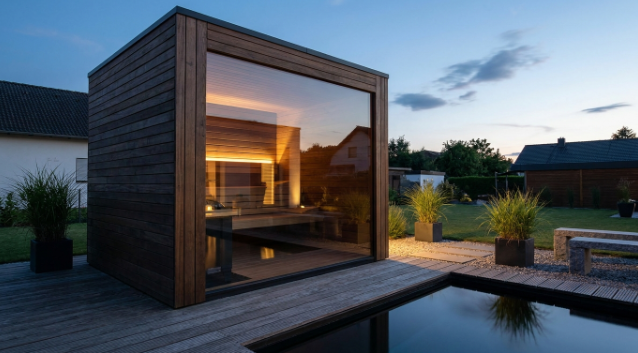

Electric heaters are the default choice for a cube sauna because the flat roof and glass-heavy walls were designed around a clean, ventless install, typically costing $600 to $1,800 for a 4.5 to 8 kW unit plus $300 to $900 in electrical work. Wood-fired heaters work in a cube design too, but the flue has to punch through that flat roof, which means extra flashing, clearance planning, and usually $500 to $1,200 more in labor than electric. The right call depends on whether you already have cheap firewood and how much you value walking out, flipping a switch, and having a hot room in twenty minutes.
Why Do Most Cube Sauna Buyers Default to Electric?
The cube format is built around a minimal, boxy silhouette, often with a full glass door or a panoramic window wall on one side, and a flat or barely sloped roof. That roofline makes routing a wood stove flue awkward: instead of a natural gable peak to punch through, installers have to cut and flash a hole in a flat surface, which is more prone to leaks if it’s not done correctly. An electric heater sidesteps the problem entirely. It mounts against an interior wall, draws power through a single conduit run, and needs no roof penetration, no chimney, and no clearance zone for combustion byproducts. For a structure whose whole design language is clean lines and glass, that matters more than it does on a traditional peaked cabin.
What Does Wood Heat Actually Require in a Cube Layout?
A wood-fired heater in a cube sauna still needs a stovepipe run through a fire-rated roof jack, with clearance to combustibles that typically forces the heater away from the glass wall and toward a solid corner. That corner placement can eat into the tight floor plan of a 4×4 or 5×5 cube more than it would in a larger cabin. You’ll also need a spot to store split wood near the unit, which most cube sauna owners, given the format’s small-footprint appeal, don’t have room for without adding a separate rack or shed. None of this makes wood heat impossible in a cube, but it works against the format’s main selling point, which is a compact structure that drops into a tight yard with minimal fuss.
How Much Does Each Option Cost Installed?
Electric: a 4.5 to 8 kW heater sized to a typical cube interior runs $600 to $1,800 for the unit. If there’s already a 240-volt circuit nearby, connecting it might cost $200 to $400 in electrician labor. Running new wire from the panel, common with a freestanding backyard cube, usually adds $500 to $1,200 depending on trench length and whether the run is buried or overhead.
Wood-fired: heaters for a compact cube run $900 to $2,200, generally pricier than an electric unit of comparable output. The stovepipe, roof jack, and fire-rated flashing kit typically add $500 to $1,200 in materials and labor, more than on a peaked roof because flat-roof penetrations require more careful sealing to prevent water intrusion. All-in, a wood-fired cube setup commonly lands $500 to $1,000 above an equivalent electric install once you account for the roof work.
Which One Heats a Cube Faster?
Electric heaters in a cube reach target temperature, usually 170 to 190 degrees Fahrenheit, in about 20 to 30 minutes thanks to the smaller interior volume most cubes have compared to larger cabins. Wood-fired units take 45 minutes to over an hour to reach the same range, since you’re building a fire from cold and waiting for the rocks to fully heat through. For a cube sauna used on a weeknight after work, that gap in warm-up time is often the deciding factor, more than the fuel cost itself.
What About Long-Term Upkeep?
Electric heating elements in regular home use typically last 5 to 10 years before replacement, a repair usually in the $150 to $400 range. Stones on top need swapping roughly every 1 to 2 years since heat cycling cracks them over time, though a fresh set of rocks costs under $50. Wood-fired heaters carry a different upkeep load: the stovepipe accumulates creosote and needs periodic cleaning, and the roof jack and flashing should be inspected each year for water intrusion, since a flat-roof leak around a chimney penetration can cause real damage to the cube’s structure if it’s missed for a season. If you’re weighing a specific model, checking listed heater wattage and clearance requirements at a retailer such as SweatDecks against your available electrical service is a faster way to narrow the decision than comparing marketing photos of finished backyards.
Does the Glass Wall Change Anything About Heat Retention?
Cube saunas lean heavily on glass, sometimes a full panoramic wall, which trades some insulation value for the view and the light. Double-glazed sauna-rated glass helps, but a cube with a large glass face still loses heat faster than a solid cedar cabin of the same footprint, which is why cube heaters are often sized slightly above the general one-kilowatt-per-fifty-cubic-feet rule. This affects each heat source differently: an electric unit with a thermostat simply draws more power and holds temperature automatically, while a wood-fired heater needs the fire tended more actively to keep pace with heat loss through the glass. Buyers in colder climates who want the glass wall look should factor this into heater sizing rather than assuming standard charts apply directly.
What Clearances Does Each Heat Source Need Around the Glass?
Electric heaters need standard clearance from any wall, typically a few inches per the manufacturer’s spec sheet, and most cube layouts place the unit on the solid wall opposite the glass, which keeps clearance simple. Wood-fired heaters need more generous clearance from combustible material, and while tempered sauna glass is not combustible, the wood trim and door frame around it usually are, so the heater still has to sit further from that side of the cube. In a small 4×4 or 5×5 interior, that clearance requirement can force the wood-fired heater into a corner that eats into usable bench space, another reason electric remains the more common choice in this format.
So Which Heat Source Actually Wins for a Cube?
For most buyers, electric wins on total cost, install simplicity, and how well it matches the cube’s flat-roof, glass-forward design. Wood-fired heat can still make sense if you have a steady, low-cost firewood supply and you specifically want the ritual of tending a fire, and you’re willing to pay more upfront for the roof penetration work done correctly. What rarely makes sense is choosing wood-fired heat for a cube purely on the assumption that it’s the cheaper option, since the roof and clearance realities of this particular shape tend to erase most of the savings that wood-fired heat offers on a traditional gabled cabin.
Frequently Asked Questions
Can a cube sauna run on a wood-fired heater?
Yes, but the flat roof needs a properly flashed flue penetration, which adds cost and complexity compared to an electric unit that needs no roof opening.
What size electric heater does a cube sauna need?
Most cubes in the 4×4 to 6×6 foot range use a 4.5 to 8 kW heater, sized to roughly one kilowatt per 45 to 50 cubic feet of interior volume.
Do cube saunas need a 240-volt circuit?
Heaters above 6 kW generally need a dedicated 240-volt circuit, while smaller electric units under 4 kW can sometimes run on a heavy-duty 120-volt circuit.
Is a wood-fired cube sauna cheaper to run than electric?
Only if firewood is essentially free to you. Once the chimney installation and fire-tending time are factored in, wood-fired heat rarely beats electric on total cost.
References
- “Cardiovascular and Other Health Benefits of Sauna Bathing: A Review of the Evidence.” Mayo Clinic Proceedings, 2018. https://pubmed.ncbi.nlm.nih.gov/30077204/
- “Clinical Effects of Regular Dry Sauna Bathing: A Systematic Review.” Evidence-Based Complementary and Alternative Medicine, 2018. https://pubmed.ncbi.nlm.nih.gov/29849692/
- “Benefits and risks of sauna bathing.” The American Journal of Medicine, 2001. https://pubmed.ncbi.nlm.nih.gov/11165553/
- Underwriters Laboratories. https://www.ul.com/
By Marcus Feldman